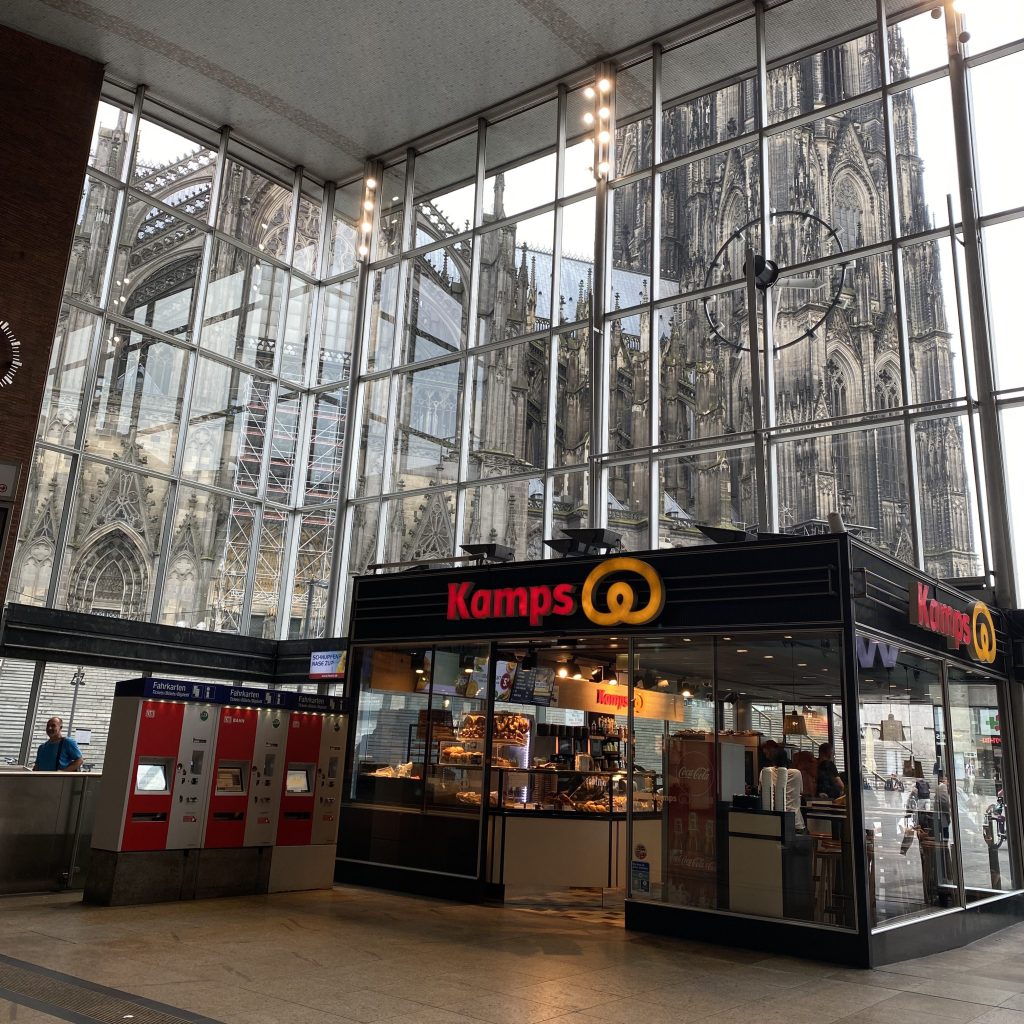

While traveling by train in Germany can be a very, very stressful task, it is also the cheapest and most efficient option. So, I’ve created this guide to hopefully turn down the stress levels as much as possible.
General Info
Hauptbahnhof
I’m sure you would’ve picked this up somewhere along the way, but “hauptbahnhof” (often abbreviated as HBF) is the German word for main train station. It’s almost always located at the city center, since for most German cities the hauptbahnhof was one of the first buildings established there and it’s what connects the city to the rest of the country.
The trains usually have other stops within the cities, but the hauptbahnhof is the main terminal that you’ll usually want to travel in and out of. All S-Bahn and U-Bahn trains will travel through here, so when in doubt this is a good spot to be.
While we’re learning German, another important word is “bahn” which means train.

Reisezentrum
The German word for travel center, this is where you can go to get a train pass catered to your needs. They’ll find you the cheapest pass for your trip, and fill you in on just about anything you need to know. They’re a fantastic asset to help you on your journeys, so make sure if you have any questions to follow the signs to the reisezentrum usually located within the hauptbahnhof.
Also just a general note: just about everyone under 50 speaks English in Germany, so if you need to ask for directions try to find someone on the younger side.
Short Distance City Travel
City Train Charts and maps
This is probably a no-brainer, but make sure you check the maps anytime you’re at a train station. They’ll tell you what trains go where, and there’s also usually a time table right next to them that will tell you when each train is scheduled. The trains have specific times that they stop at each station each day, and they’re usually within a few minutes of being on time – if you’re lucky, that is. Delays happen often, ESPECIALLY in the summer, so be prepared and arrive at the station early.
Local Transportation App
For traveling within one city, I recommend downloading their individual local city transportation app. You can plug in your departing and arriving stations and it’ll let you purchase tickets through the app with ease. You can typically buy tickets for S-Bahn and U-Bahn, RB, RE, IC and ICE trains as well as bus tickets via this app.
I know that for Stuttgart the app is VVS, Cologne the app is KVB, Berlin is BVG and Munich is MVV, but outside of that give it a Goog and I’m sure you’ll be able to figure out what app you need.
S-Bahn
The S-Bahn is essentially a slightly longer-distance version of the U-Bahn. It travels faster, with more time between stops, and its network usually spreads out across a wider area (nearby towns are often within their system).
U-Bahn
The U-Bahn is what Germans call any intra-city subway system. It travels somewhat slow, it’s often very crowded, and it stops very frequently (it’s usually a 5-10 minute walk between stops, for reference). However, there are many stops and, compared to the U.S. and most other countries, it’s a pretty dang good system.
Ticket Checkers
While you may get lucky and never run into them, just know that they are out there – and if you do get ticketed, it won’t be cheap. Ticket checkers on U-Bahn and S-Bahn trains are usually plainclothesmen, so it’s tough to identify them before they actually get up and start checking tickets. They check tickets between stops, so it’s a bit harder to avoid. I recommend you just spend the €3 or whatever it is for a ticket instead of having to pay a €100 fine.
Short-Medium Distance Travel
Deutschebahn (DB)
For anything following this, I recommend downloading the DB app. Deutschebahn is the main train company in Germany, and it’s basically a longer-distance version of the local transportation app from my experience. It makes it very easy to purchase tickets for medium-long distance travel.
As for their trains, they’re usually pretty comfortable and clean. I’ve traveled with them many times, and I don’t remember ever being disappointed.
RegionalBahn (RB)
Regionalbahn is the short/medium distance version of the long distance trains. These trains will have RB before their train number (ex. RB952), and will usually travel within a few cities in whatever German region you’re in and make frequent stops along the way. They aren’t as fast as the longer distance trains, but they definitely get the job done.
Regional Express (RE)
This is essentially a slightly faster version of Regionalbahn. These trains will have RE before their train number.
Long Distance Travel
Inter-City & Inter-City Express (IC & ICE)
These trains are longer distance, with fewer stops and traveling at faster speeds. They’ll take you to just about any hauptbahnhof in Germany, and they’re usually pretty cheap. You can usually purchase tickets for these trains on the local transportation app.
Depending on where you’re going, these trips can still take a while depending on the distance so I recommend bringing a neck pillow since it’s honestly not likely that it’ll be a very comfy ride. I recommend Deutschebahn over this, since it is much more comfortable and more clean, but this will get the job done at often a lower price.
I would understand if this guide may have confused you a bit, but trust me – it’s way more confusing when you arrive and everything around you is in German.
Good luck, stay safe and happy travels!

Leave a comment